

What Is Chicory Root? Uses, Inulin and Chicory Coffee
Oct 28, 2026
Chicory root is the root of the chicory plant (Cichorium intybus), a blue-flowered member of the dandelion family. It's best known for two things: inulin, a type of dietary fibre that makes up a large share of the root, and chicory coffee, a caffeine-free hot drink brewed from the roasted root.
Here's what chicory root is, how it's used in food, what the research says about its benefits, and where it fits in our plant-based grounds.
| Chicory root at a glance | Details |
|---|---|
| Plant | Cichorium intybus, part of the Asteraceae (dandelion) family |
| Main compound | Inulin, up to 70% of the root on a dry weight basis |
| Common uses | Inulin fibre, coffee substitute, food ingredient |
| Taste | Bitter when fresh, so it's usually roasted or otherwise debittered before use |
| Caffeine | None |
| Status in Canada | Inulin from chicory root is on Health Canada's list of accepted dietary fibres |
What is chicory root?
Chicory root comes from Cichorium intybus, a perennial plant with bright blue flowers that has been grown since ancient times. It belongs to the same genus as endive, and to the wider Asteraceae family that includes dandelions.
The leaves can be eaten raw or cooked. The root is the part used for inulin and for chicory coffee.
What is chicory root used for?
Chicory root has three main uses: industrial extraction of inulin, a coffee substitute, and animal feed. In food, the inulin taken from the root shows up on a lot of ingredient lists.
Food makers use inulin-type fibres as partial replacements for fat and sugar, and to change texture. A 2022 review in Food Science & Nutrition notes that how much you replace matters, because it can change how a food looks, feels and tastes.
What is inulin?
Inulin is a non-digestible carbohydrate, part of a group called inulin-type fructans. It's classed as a prebiotic, which means it feeds certain gut bacteria rather than being digested by you.
Chicory root is the main commercial source. It holds up to 70% inulin on a dry weight basis, while foods like wheat, bananas and onions contain only small amounts. To make inulin, the root goes through hot water extraction, then purification.
In Canada, inulin from chicory root is on Health Canada's list of dietary fibres reviewed and accepted by its Food Directorate, as a traditional fibre made by hot water extraction.
What are the benefits of chicory root?
Most of the research on chicory root is about its inulin fibre, and the best-supported benefit is for gut bacteria. A 2023 systematic review and meta-analysis of 50 studies with 2,525 participants found that chicory inulin-type fructans, at 3 to 20 g a day, may increase Bifidobacterium and may improve bowel function in healthy people. The effect on Bifidobacterium didn't hold in people with gastrointestinal disorders.
A smaller 2019 trial found that 10 g a day of chicory inulin increased stool frequency in people who had low stool frequency to start with. That trial was small (10 people completed the first part, 20 the second) and was funded by an inulin maker, so treat it as one data point.
Those amounts are for inulin taken as a supplement or added fibre, not for chicory root as one ingredient among several.
Can chicory root cause bloating?
It can, for some people, at higher amounts. In a 2010 study of 26 healthy adults, chicory inulin caused mild increases in gas and bloating. The researchers concluded that up to 10 g a day of native inulin, and up to 5 g a day of the shorter-chain form (oligofructose), were well tolerated in healthy young adults.
Inulin is a fructan, one of the FODMAP carbohydrates. Monash University's FODMAP team notes that FODMAPs can trigger symptoms in people with irritable bowel syndrome, and that fructans increased gas in the large intestine in one study of healthy volunteers. If you're managing IBS, check with your dietitian.
What is chicory coffee?
Chicory coffee is a hot drink brewed from roasted chicory root, used in place of coffee or blended with it. The plant has a long history as a coffee substitute, and it's one of its best-known uses.
Fresh chicory root tastes quite bitter. To take the edge off, the roots are usually roasted (or boiled, dried or soaked), then chopped or ground before they're used in coffee blends or as a food ingredient.
Does chicory coffee have caffeine?
No. Chicory coffee is brewed from the root, not from coffee beans, and the absence of caffeine is one of the main reasons coffee substitutes like it have become popular. If it's blended with regular coffee, the coffee part still brings its own caffeine.
Why is chicory root powder in our plant-based ground?
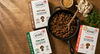
Chicory root powder is in all three of our grounds: Natural, Italian and Chorizo. Natural keeps the list shortest: Water, Protein blend (pea protein, oyster mushroom), Mushroom extract, Chicory root powder, Salt. That's it. Five ingredients and 21 g protein per serving. Italian and Chorizo build on the same base with their own seasonings.
Chicory root powder is mostly inulin, the fibre food makers use to shape texture and stand in for some fat, so it helps the ground stay moist and hold together as a crumble. If you want the full story on why we keep our list this short, read Clean-Label Plant-Based Meat Made in Canada. For the protein side, see what oyster mushroom protein is and why it matters.
All three of our grounds are made without soy and gluten and may contain cashews. More on that in our guide to gluten-free and soy-free plant-based meat.
FAQ
Is chicory root the same as chicory coffee?
Not quite. Chicory root is the root of the plant. Chicory coffee is a drink brewed from that root, usually roasted, and used in place of coffee.
Is inulin considered fibre in Canada?
Yes. Inulin from chicory root is on Health Canada's list of dietary fibres reviewed and accepted by its Food Directorate. It's listed as a traditional fibre made by hot water extraction.
Can chicory root upset your stomach?
At higher amounts it can cause gas or bloating in some people. In one study, healthy adults tolerated up to 10 g a day of native inulin. People with IBS may be more sensitive, since inulin is a fructan, one of the FODMAPs.
Is it okay to have chicory root every day?
For most healthy people, in moderate amounts, the research suggests yes. Studies in a 2023 review gave people 3 to 20 g of chicory inulin a day, and a 2010 study found up to 10 g a day of native inulin was well tolerated by healthy young adults. If you notice gas or bloating, cut back, and if you're managing IBS, check with your dietitian.
What's in The Better Butchers Natural ground?
Five ingredients: Water, Protein blend (pea protein, oyster mushroom), Mushroom extract, Chicory root powder, Salt. It has 21 g protein per serving, is made without soy and gluten, and may contain cashews.
How do I cook the Natural ground?
Add a little oil to a hot pan, add the ground and brown it for about 5 minutes, until it's browned at the edges and crumbly. Our cooking guide has the full method, plus storage and reheating tips.
Sources
- Birsa ML, Sarbu LG. Health Benefits of Key Constituents in Cichorium intybus L. Nutrients, 2023.
- Nwafor IC et al. Chemical Composition and Nutritive Benefits of Chicory (Cichorium intybus) as an Ideal Complementary and/or Alternative Livestock Feed Supplement. The Scientific World Journal, 2017.
- Jackson PPJ, Wijeyesekera A, Rastall RA. Inulin-type fructans and short-chain fructooligosaccharides: their role within the food industry as fat and sugar replacers and texture modifiers. Food Science & Nutrition, 2022.
- Health Canada. List of Dietary Fibres Reviewed and Accepted by Health Canada's Food Directorate (updated June 2021).
- Effect of chicory-derived inulin-type fructans on abundance of Bifidobacterium and on bowel function: a systematic review with meta-analyses. Critical Reviews in Food Science and Nutrition, 2023.
- Watson AW et al. Changes in stool frequency following chicory inulin consumption, and effects on stool consistency, quality of life and composition of gut microbiota. Food Hydrocolloids, 2019.
- Bonnema AL, Kolberg LW, Thomas W, Slavin JL. Gastrointestinal Tolerance of Chicory Inulin Products. Journal of the American Dietetic Association, 2010.
- Monash University FODMAP. Not all FODMAPs are equal.